Showing posts with label Communications. Show all posts

28 November 2013

The FM's Party Survival Guide

Traditionally, the beginning of December heralds the onset of the work's-Christmas-party season. Whilst there are many who look forward to the prospect of getting a little tipsy and having a boogie with colleagues, for many in the FM  industry the very thought of sitting down to a turkey dinner with work's-people fills them with dread.  In this blog I explore the reasons why and give some of my party survival tips.

So what exactly do Facilities Managers have against the work's-Christmas-party anyway?  Well for a start it's not just the Christmas party.  In fact, it's not even just work's-parties:  A lot of us have a beef with parties in general.  And it's not because we're cantankerous, Victor Meldrew types either:  It's because in almost any party situation it's virtually inevitable that someone will ask you what you do for a living and if you work in FM, 99% of the time that conversational thread will lead to the point where you end up having to say “Well no, actually! Not like a janitor at all!”  This will be followed by about an hour of explanation as to why being an FM is not like being a janitor.  Not that there's anything wrong with being one, but it's just that the effort of having to spend all that time at parties explaining what you do (when you should be having fun) can really grind you down.

Still it could be worse: at least we're not Health & Safety Officers!  That might sound harsh, but honestly, those poor guys have it way tougher than Facilities people.  If, in a party situation, you ever find yourself foolishly happening to admit that your work involves being responsible for managing Safety, the best course of action to follow is to immediately get up from the table, step outside, hail a cab and go home...... because that's your night done!  If you're stubborn enough to stay, you'll spend the rest of the night having to justify or refute every safety measure or myth ever conceived to people with a chemically-diminished capacity for logical and reasoned discussion. It's a no-win situation.

But if parties in general are bad, in many ways the work's-party can be the pits. For a start everyone already knows that you're not a formula one driver and to make matters worse;  everyone, and yes I do mean everyone, will talk shop to an FM at a work's-party.  Now there are those who say that talking shop is par for the course and to a certain extent they're right. But....... there is a world of difference between gossiping about who is and isn't getting promoted and the relentless barrage of gripes and grumbles some FMs have to put up with. At the work's-party, an FM can find themselves facing a steady stream of people who, on account of the fact that they've just bumped into you, decide that it is surely the perfect opportunity for passing on that complaint about the air-conditioning that they haven't got round to emailing you about yet. I mean why not? It's not like you make it easy for them to catch up with you during the 'normal' working day by being at work, having a phone and an email account is it?  At Christmas parties past, whilst everyone else has been busy occupying themselves by eating mince pies and trying to work out who Sarah-from-Accounts has been disappearing into the stationary cupboard with,  I've had my evening wasted justifying the recycling policy, getting feedback about cleaning, explaining air-conditioning, hearing everyone's opinion of the vending coffee, etc, etc, ad infinitum. And it's not that I normally mind talking about that stuff, it's just that, well...........it's a party: I'm here to have fun like everyone else!

The list of minor groans and grievances you can face at a party can almost be enough to put you off going. Almost. But you shouldn't be deterred: FMs make a huge contribution to an organisation's success and they have every right to celebrate that success with colleagues.  Not only that, but it's a great way of engaging in the culture.  In fact, one of the reasons many FMs suffer from such a hard time at work's-parties, is that they fail to identify it as an engagement opportunity and therefore don't go adequately  prepared. 

So if all of this sounds a little too familiar, allow me to share with you my top tips for Christmas-party survival.


1:  If you're off the clock, be off the clock

Some people say that that listening to moans and groans goes with the job, but I say that it's just plain rude.  Between courses I might well spend time engaging in speculation with colleagues about the extent of Sarah-in-Account's extra-curricular activities, but if I was to collar her at the bar and give her a hard time about the speed and accuracy of her invoice coding, most people would say I was "bang out of order: It's a party for heavens sake!"   So be prepared to politely and firmly stand your ground:  There is absolutely nothing wrong in saying “I'd really like to talk to you about this on Monday, but it's a party so do you mind if we don't talk shop?”

2:  People love to hear themselves talk

Something that not all FMs realise is that......... it's not just FMs who feel like nobody understands what they do and how important it is.  Honestly: it's true! If you don't want to be caught with the what do you do? question, why don't you be the one who asks it instead?  Making people feel like they're important to you and that you want to understand them is a great way to forge new alliances and build trust.  And who knows: you might just find out something useful.....

3:  The best defence..........

If like me, you are one of those people mentioned in the tip above who really love do to hear themselves speak, you just might struggle a little with my second tip, but that's ok I have a third one for you:  try treating it as a public relations opportunity. Instead of waiting for people to approach you with a complaint, why not go in armed with your list of recent successes and exciting future plans and solicit feedback?  Try saying things like, “We're considering going fair-trade when we re-negotiate the vending next year..... do you think we should?“  Of course, everyone is going to say yes and you're going to do it regardless anyway, but.... they don't know that: Their perception could be that they are making a contribution to the decision making process and when you eventually  bring it in, they may even see it as a shared success. Result!

4: The three-hit-combo

As any boxing fan will tell you, victory rarely comes with a single blow, but through skilfully delivered combinations.  To make the best of these tips, use them all together: Ask about them, fend off the complaint then solicit some positive feedback.  It takes skill and practice but master it and they'll be putty in your hands.  And if all else fails, there's always tip number five.....

5: The master avoidance strategy

If you've tried all the above and you're still getting grief, it's time to beat a tactical retreat to the dance floor. Now let me tell you, many people claim they can multi-task, but it is quite literally impossible to have a serious discussion about car-parking whist doing the Macarena or the Cha-Cha-Slide. Frankly anyone who can manage it probably deserves their own parking space anyway! Now if you've seen me busting-my-moves, you'll understand that this high-risk strategy is not to be taken lightly, but it can be brutally effective in a sledgehammer-to-open-a-walnut kind of way. There is even a very slim possibility that if you manage to pull it off extremely well, then at next years party you might just discover yourself being the subject of speculation about what Sarah-in-Accounts has been up to! Now go! Get out there and have fun! 

Merry Christmas.

12 May 2013

Dances With Wolves

If there existed such a thing as a Facilities Management rule book, it is generally held that rule number one would be “develop good relationships with your stakeholders”.  So why does the idea of engaging certain groups of stakeholders fill an FM with dread?  Let me explain using one of my favourite techniques: the animal simile.  Stakeholders are like wolves.

Those who know me well, know that I love a good simile. And no, that’s not a miss-spelling of smilie, although if you follow me on twitter (@JGurd) you’ll know that I also love a good smilie :)  . People are always saying that standards in education are declining, but ask any 8 year old what a simile is and quick as a flash they’ll tell you that it’s a figure of speech which is used to compare things to one another by using the words like or as. Pretty smart people, those kids and they even know a thing or two about smilies, but that’s digressing even more so I’ll try to get broadly back on track with the point I was making; I am particularly fond of the animal simile.  Through popular culture, childhood impressions, etc, we naturally endow certain animals with particular qualities or characteristics; lions are regal, mice are quiet, foxes are cunning and donkeys are well.........  well, let’s say fortunate.  And this is kind of my point, I haven’t said it, but you know exactly what I mean and this is why the animal simile works so well – the associations feel perfectly natural.  So let’s get back to my rather outlandish statement shall we? Not the one about donkeys, the other one.  Why is it tempting for a Facilities Manager to hide out in the plant room all day and avoid their stakeholders? Because stakeholders are like wolves.  Allow me to explain......


Regardless of how soft and furry it may appear on the outside, we instinctively understand that deep down  a wolf can be a fearsome predator, with sharp teeth, wicked claws and a killer instinct.  They might look a lot like man’s best friend, but they’re feral beasts and an unplanned or unexpected encounter with one and you could well end up with more than a few chunks being torn off. Basically, just like stakeholders.

Of course there are degrees of deadliness: The lone wolf, grizzled veteran of a thousand fights can be the most fearsome of all, but even a cub can take a finger if you’re not paying attention.  But worst of all, just like stakeholders, wolves are at their deadliest when they hunting in packs.
Almost all Facilities Managers will have at some time experienced that entering the lion’s den feeling that is a prelude to meeting with a large group of stakeholders.  They tend to be monthly meetings and I have a theory that I’m working on that it has something to do with lunar cycles – I can’t prove it, but mine mostly seem to fall on the same day as the full moon..........  Coincidence I’m sure.

As we step into that meeting, we know that we are going to be significantly outnumbered. It can feel like being circled by sharks and you know that as soon as they scent blood in the water, there’s going to be a feeding frenzy.  As you shuffle your agenda and your notes from the previous meeting, your pulse quickens and from somewhere deep down something primal pushes to the surface. Instinctively you prepare yourself for fight or flight.

So should you fight or should you flee?  Which is the best choice? Actually it’s neither. There is a third way which is all about getting your attitude right in advance as I’ll explain shortly, but first, let me try to explain why you should ignore that instinctive response.

Ok, so we wouldn’t actually fight in a meeting and probably wouldn’t go quite as far as running out the door screaming either, but in a modern day business context, you could think of them instead as going in all guns blazing or adopting a strategy of appeasement. 

Fighting it out can seem initially attractive. You can refuse to accept any criticism or blame, counter your opponent’s claims and blind them with science, etc. If you’re aggressive enough, you can probably even push the blame right back at them for failing to read the memo, not filling in the form, etc, etc.  If you go in all guns blazing, you’ll probably put the fear of god in them and they’ll never dare criticize you again which is a surely a good thing right? Well not really. It doesn’t actually work like that: if they don’t feel like they can talk to you, in the future, they’ll just go behind your back, around you or over your head. As an FM you almost certainly have the skills to win most of your battles, but FM is about cooperation not confrontation; what are you fighting for? If you’re trying to win hearts and minds, winning battles can cost you the war.

With that in mind, you might decide it’s just easier not to be confrontational at all. If you just give everyone whatever they ask for, they’ll all be perfectly happy and they will just leave you alone right?.  Well.... before you choose a strategy of appeasement, there’s something you should know: it didn’t work in the run up to the Second World War and it doesn’t work now.  Ultimately, demands are not always reasonable; if you agree to everything, eventually you’ll end up promising things you can’t deliver and your stakeholder frustration will increase.

So let’s talk about the other way instead.  Our ancestors learned how to domesticate the wolf and we too can learn to tame the stakeholder.  There are limits of course: they’re not going to chase sticks or retrieve your slippers, but it is definitely possible to develop mutually beneficial relationships and even get them working for you, being your eyes and ears and championing your causes. The key is getting the balance right; less fear, more respect, more confidence, less aggression. Most importantly of all, remember that communication is a two way process: if you give you should also take.


So how does that work in reality?  Well this blog was inspired by some advice I recently gave to a peer about stakeholder meetings which went something like this:  You should always participate in meetings as an equal: remember that you are there because of your skills, knowledge and expertise. Be confident but not aggressive:  you are not there as a punch bag and you are certainly not there to spend your time apologising for the level of service, but that doesn’t mean you shouldn’t listen and learn. Don’t be defensive; accept constructive feedback and never tell people that their experiences of the service are wrong – if someone is cold, no amount of telling them that they're not will make them any warmer or happier. If you can learn something from the things they tell you, you may be able to improve the service.  Most importantly, remember that communication is a two-way process; the pact you make with your stakeholders is that; in return for getting direct access to you to raise team complaints, you get to use them as a conduit for communicating information in the other direction.  And it doesn’t hurt to give a little constructive feedback of your own. After all, if you’ve listened to their views about the way the front desk works, then quid pro quo, you’re perfectly entitled to ask them to try and get their teams to be more considerate when using meeting rooms.  Finally, remember that, this is your opportunity to talk about the good things you’ve done and the good things coming up. It’s your chance to spread the vision.

So going back to wolves. As I mentioned earlier, like stakeholders they can be at their most effective when they work as a pack and with the right balance of attitude, respect and communications, you could find the pack working on your behalf; disseminating your message and spreading your vision.  And when that happens, the sight of the moon, full in the night sky will have you howling for joy, rather than trembling in fear.

25 January 2013

And the survey says.........

We asked one hundred Facilities Managers what the golden rule of FM was? And they said......... “keep your customers happy”.  Then we asked..... how did they know how happy their customers are, or, if they were more or less happy than they used to be?

And they said......... “Um, well, I’m not sure really. I mean they don’t complain as much for a start. I suppose you could always do a workplace satisfaction survey of some kind, but what sort of questions would you ask? And do they really tell you anything useful anyway?”


OK, so I admit the opening part of this blog is somewhat fabricated, but it is a situation that many FMs will recognise.  The consensus of opinion seems to be that surveys are a good idea in principle, but the results don’t often tell you that much.  I disagree.  What the results usually tell you is how well the survey was planned out before it was published.

The whats, whys and wherefores

The problem is that most surveys start life in exactly the way described above.  Someone makes the decision that we need to find out how happy our customers are, someone else suggests a survey, then everyone starts brainstorming the questions, someone writes them down, they get circulated and a load of junk comes back.

For a survey to be an effective tool, you need to break the process before the brainstorming, wind it back a few notches, accept a few universal truths and put a little thought into the whats, whys and wherefores. 

The truth?  You can’t handle the truth!

One of the first things you need to establish is why you are measuring satisfaction.  It sounds obvious, but it’s not.  If we’re honest about it, many surveys don’t set out with the altruistic objective of simply finding out how happy people are, cynically, many are sent out as a way of trying to prove that a certain standard is being delivered.  If your objective is more cynical, you should be warned that it could well back-fire. The people most likely to respond are those who have something to complain about. 

Of course if your goal is to find out what is wrong so you can try and fix it, well..... you’ll rarely have a problem finding people who will tell you what is wrong. Fixing these things of course is down to you and you should be aware that if you’re the one asking the question, then you’ll be setting an expectation that you will act on the information you’ve asked for. 

Great expectations

Sometimes there is an assumption that survey results can tell you how well the service is being delivered. Usually they can’t. The customer’s response to the survey depends on how well their expectations are being met.  But expectations are a slippery business and they should not be confused with truth or fact. They’re not always fair, logical or reasonable and they can change based on experience. You may be delivering gold-standard service, but if the customer expects platinum-standard they will mark you down.

A survey can be a useful  way to gage and measure your customer’s expectations and as we’re all fond of saying in the world of Facilities Management: if you can measure it, you can manage it. Expectations are no exception.  My recommendation is that you actively invite comment and welcome discussion. The information and engagement you get in return will often teach you far more about service performance than the actual statistics. It also shows you customers that you value what they have to say.

iPads and holidays

Something very important to understand about your workplace satisfaction survey, is that the only people really interested in it, are you, maybe your boss, and everybody with an axe to grind.  Think back to the last survey you filled in – it was a pain right?  Why did you do it? Oh that’s right, you wanted to win an iPad ..............


I’m presuming your facilities survey budget probably doesn’t even stretch to a year’s supply of post-it-notes, so do try to accept the fact that most people will not want to fill it in.  Sorry - that’s just how it is.  But if you do want to maximise your returns, the most effective way is to make it really quick to do and really, really, easy. Think pretty hard in advance about the format and agree a few principles up front.  Here are some of my suggestions:

Keep the number of questions to a minimum
If you can, aim for less than ten. If it takes more than 60 seconds, most people will be turned-off from doing it.

Use a simple scoring system. 
I like 1-to-4 rather than 1-to-5. It stops people sitting on the fence – Is it good or not?  If you do use 1-to-5 then personally I suggest you treat 3 or below as a failure. Are you content that your customers are satisfied with your service?  You shouldn’t be: the golden rule of is to keep your customers happy, not satisfied.  

Phrase your questions exactly the same way
Keep your question and answer format the same for every question.  If you know that 4 is always the top score and 1 the lowest, it’s much easier to answer the questions. If your question change polarity half way through, people often won’t notice and will score it in the same manner as the one above. You may have to rephrase a question to switch it from positive to negative to do it (i.e. instead of how dissatisfied, how satisfied). If you don’t you may get anomalous results in your data.  Remember most people are just scanning through it as quickly as possible to try and win that iPad.
Use simple language
Use everyday language and avoid jargon. This is true of all good communications and your survey is no exception.

Be realistic
Finally, be pragmatic about what you can realistically learn from your survey.  It’s a useful tool for continuous improvement and gauging the general feeling, but if you want to know the ins and outs of how your service is performing or perceived to be performing, well I’m afraid you’re just going to have to do it the old fashioned way: get up from the desk every now and again, take a walk around the building and ask your customers what they think.  And to be honest, if you do that, your survey statistics will look a lot friendlier too.

10 May 2012

Worth a thousand words?

Being good at communicating information to other people is an important skill for Facilities Managers. But when that information is actually quite complicated, communicating it isn’t always easy and a range of techniques needs to be used to ensure the message is delivered effectively.  At times like this I’m reminded of the old adage that one picture, is worth a thousand words.

Processing visual information


I always attend meetings with a notepad and four different, coloured pens. Whilst making notes, I tend to switch pens at random. The strange thing is, although I make notes, I almost never need to refer to them – which is quite fortunate really because my handwriting would put a doctor to shame. People often comment upon this (the coloured pens, not the handwriting) and ask me why. The explanation is quite simple: it’s a similar effect to the memory trick magicians use to remember the relative positions of cards in a deck. They’ll associate each card with a room in a house or different tube station, etc. In the same vein, I’m not so much remembering the information I write, as remembering what colour I wrote it in and where on the page it is written.  That’s because I, like most people, respond more readily to visual stimulation than other forms of communication.


As human beings, we have evolved to process visual information very quickly; Three million years ago it usually made the difference between getting lunch and being lunch. It’s a skill that has stayed with us and as a result the modern world is rich with visual content. From posters to television, from the internet to the apps on our mobile phones, we are very comfortable in getting our information in bright, shiny, primary colours and an effective communicator can take advantage of this principle to help them get their point across.

Understanding relationships

I first discovered the power of communicating information visually a couple of years ago. I was looking after an old building where the air-conditioning was in fairly poor order with a number of faults that needed to be addressed. The problem was exasperated by the fact that, what had been intended as an open plan space, had been subsequently partitioned without much consideration to the environmental systems. This had left Fan Coil Units spanning rooms and wall mounted controls serving units in other rooms.  It was a bit of a mess.To resolve the issue, we commissioned our maintenance company to do a full survey of several floors and come up with a cost for putting it right. The trouble was that even I hadn’t appreciated how much work needed doing. I ended up with a 90 page report (one for each fan coil) and a quote that made the director’s jaws hit the floor.
I was told I’d have to prioritise; do the greatest good first, and programme the rest for the following year. 


This left me with a bit of a dilemma – how to work out where money spent would deliver the greatest value? Fortunately, I had two sets of data I could draw upon to help me: I had quote (which I had asked the supplier to break down for me) and I also had some customer complaint data on a room-by-room basis that I could use as my justification. 


One slight complication though, was the whole open-plan/partitioning issue. Fixing a problem might involve working on more than one room at a time, so it wouldn’t be quite as simple as listing the rooms and listing the cost to fix them. Instead I decided to present the information visually. It looked something like this.


One of the ways using visual methods of communications excels over other forms, is the way in which it allows you to efficiently describe relationships. I colour coded the rooms on a simple traffic light system to show the complaint level and overlaid this with each of the pieces of work showing which areas they would impact and what the costs of that work would be. It took me two whole days to pick through the detail of half-a-dozen floors, but one meeting and ten minutes later, I’d managed to secure a lot more funding than I’d been led to believe was available. You see, seeing it in a visual format, allowed my stakeholders to relate to the data and to understand both the scale of the problem and what they would get for their money.

Visually interesting


Since that first success, I’ve experimented with a lot of different visual communications techniques. I’ll admit they can take a little time to prepare, but if they help get your message across and help you achieve the results you need, then that can be time well spent.
One of the things I’ve noticed is that visual communication can be extremely effective when you present your information in an unusual way. Especially if the way you communicate it helps people relate to what it is. If you can capture someone’s interest, the battle is already half-won. 


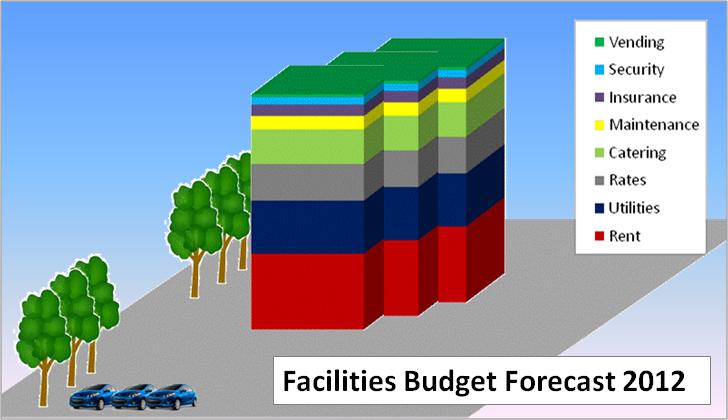
The graphic above is a recent favourite of mine.  At heart, it’s actually just a basic bar-graph of an FM budget, but to make it more interesting I’ve cut and pasted it together so that it looks like a building. To reinforce the message I’ve added a couple of trees and cars.  I really like the message that this gives, the fact that everything up to the first floor is the rent is something people can easily relate to without having to know the actual percentages or figures and if you can make it the same shape as your building, people will find it very easy to relate too.

The power of metaphor

I often find myself having to communicate information in stand-up presentations. I used to create very content-heavy PowerPoint slides to accompany my words when I did this, but that all changed when I saw what was probably, the best presentation of my life: It had no words, just three different pictures of dogs.  The speaker pulled up each picture in turn and explained why they were a metaphor for what his department was doing. It was something I’d never seen before and I was immediately sold.


Recently, I used this image in a similar fashion.  I told my assembled industry colleagues that I thought it was the perfect metaphor for Facilities Management: lonely at times, challenging, exhausting, but ultimately, incredibly satisfying and personally rewarding. The whole room nodded in unison.

Don’t tell me, show me.

So next time you need to communicate something complicated to a customer or stakeholder, spare some consideration for using a visual communications method: Remember, one picture really can be worth a thousand words.