31 January 2013

SLAs: A help or a hindrance?

A report from the debate at the 32nd FM Forum in Stansted

There was a sharp intake of breath from across the room as Liz Kentish posed her opening question in the debate about the usefulness of SLAs.  The assembled delegates looked around the room to find only two half-raised hands in response to the request about who would consider getting rid of their SLAs altogether.  One of those hands was mine, although I had only half-raised it – I’ll get to that bit later.


To be honest, our expectations going into the debate were quite modest. Being on as the last show of the day (and after the bar has opened) is not traditionally the best slot, but I’ll admit we were pleasantly surprised by the turnout and even more pleasantly surprised by the extent of audience participation. It would appear that SLAs are a contentious topic. In fact, this very report is a product of the ongoing interest we received after the debate.

I think it was a strong and diverse panel – that’s something that always helps a debate go well.  With myself (Jason Gurd) providing the client-side view, Robert Cunliffe the service-provider perspective, Adeyemi Adeboye providing expertise of operating PFI contracts. The debate was chaired by the BIFM Deputy Chair, Liz Kentish.

The panel put forward their cases and invited input from the audience.  There was some initial discussion about whether SLAs served any real purpose, with myself suggesting that most of us just settle for supplier’s out-of-the-box SLAs anyway. I’d already made the point that, getting to me in 4-hours wasn’t really all that impressive when you considered how far I could get from Stansted in 4-hours.

It was debated whether SLAs offer more protection to the client or the supplier, with cases being made for both sides. There were suggestions that SLAs were more often stick, than carrot, a get out-clause, if you like and the practicality of actually using that stick was also discussed. 

 Adeyemi and Robert both made strong cases for SLAs being a way to manage expectations and although there was a general consensus that they couldn’t replace a good client/supplier relationship, Adeyemi was able to use his knowledge of PFI to demonstrate that there are times when the client is significantly removed from the delivery.  This led to the almost inevitable question about whether FM is too procurement driven, followed by an equally inevitable round of “procurement-bashing”.  It was light-hearted, but I did step in to support our procurement colleagues by pointing out that it was down to FM’s to demonstrate leadership and influence in specifying services, but that we also need to make use of procurement functions to help us buy more effectively.

There was a lot of discussion about whether drawing a “line-in-the-sand” was a good thing when it came to service standards or not. I argued that, whilst there is a case for KPIs, continuous improvement demands that we seek to improve. Adeyemi countered by talking about the mechanisms which can allow SLAs to develop. 

There was also a great deal of discussion about whether SLAs could really enhance the client/supplier relationship, with Robert providing one of the most interesting examples of the night about how SLAs could be used to support organisational objectives, such as offering Local Authorities SLAs relating to creating local employment.

It was a pretty heated debate and I think most people were genuinely disappointed when it came to a close. I don’t think we managed to resolve the question, but I do think we managed to make a room full of FMs decide to think a lot harder about what SLAs they will ask from their suppliers in the future. 

To wrap this report off, I’d like to leave you with the closing thoughts of each of our panellists & chair;


Robert Cunliffe       
@robertcunliffe 
http://fmfuture.blogspot.co.uk/


“SLAs should be intertwined with KPIs and penalties or credits to ensure that the service provider has a framework to understand the quality expectations of the customer.  SLAs  & KPIs should not get in the way of building a good relationship between supplier and customer to further improve or enhance services so the customer is genuinely happy, however they provide a safety net should the relationship deteriorate.  To provide a true partnership SLAs and KPIs should focus on outcomes or the customer’s business priorities, as only then will the supplier really understand what the customer really, really wants.”


Adeyemi Adeboye 
@Yemmycornelius


“Forums like these, which bring the provider and the client together to discuss how the equilibrium of demand and supply of service agreements could be improved upon, is not only a necessity but a requirement for an enhanced and positive experience.  SLAs in this modern business age are here to stay: Whether you achieve your strategic goals and objectives will be down to how you structure your service level objectives in relation to your organisational goals."


Jason Gurd 

“Even I’m not enough of a maverick to completely dispense with SLAs all together, but I do think FMs should give serious thought to what SLAs they ask for and whether they really need to be accepting all of those out-of-the-box ones.  I would suggest you might get a better service if you dispensed with the majority of your SLAs and focussed on the ones that are really important to you.”


Liz Kentish (Chair)  
@FMCoach   


“I love it when FMs get together and talk about what works!  Our debate at the FM Forum demonstrated that there is of course a place for SLAs, but they must be regularly reviewed and amended when services change.  Key to service delivery and managing expectations is the relationship between the service provider and the client, whether in-house or not.  One of the courses we run is influencing skills and managing relationships, and the feedback is always that this is what really makes a difference - get it right, as an FM, and your life will be an awful lot easier!”

25 January 2013

And the survey says.........

We asked one hundred Facilities Managers what the golden rule of FM was? And they said......... “keep your customers happy”.  Then we asked..... how did they know how happy their customers are, or, if they were more or less happy than they used to be?

And they said......... “Um, well, I’m not sure really. I mean they don’t complain as much for a start. I suppose you could always do a workplace satisfaction survey of some kind, but what sort of questions would you ask? And do they really tell you anything useful anyway?”


OK, so I admit the opening part of this blog is somewhat fabricated, but it is a situation that many FMs will recognise.  The consensus of opinion seems to be that surveys are a good idea in principle, but the results don’t often tell you that much.  I disagree.  What the results usually tell you is how well the survey was planned out before it was published.

The whats, whys and wherefores

The problem is that most surveys start life in exactly the way described above.  Someone makes the decision that we need to find out how happy our customers are, someone else suggests a survey, then everyone starts brainstorming the questions, someone writes them down, they get circulated and a load of junk comes back.

For a survey to be an effective tool, you need to break the process before the brainstorming, wind it back a few notches, accept a few universal truths and put a little thought into the whats, whys and wherefores. 

The truth?  You can’t handle the truth!

One of the first things you need to establish is why you are measuring satisfaction.  It sounds obvious, but it’s not.  If we’re honest about it, many surveys don’t set out with the altruistic objective of simply finding out how happy people are, cynically, many are sent out as a way of trying to prove that a certain standard is being delivered.  If your objective is more cynical, you should be warned that it could well back-fire. The people most likely to respond are those who have something to complain about. 

Of course if your goal is to find out what is wrong so you can try and fix it, well..... you’ll rarely have a problem finding people who will tell you what is wrong. Fixing these things of course is down to you and you should be aware that if you’re the one asking the question, then you’ll be setting an expectation that you will act on the information you’ve asked for. 

Great expectations

Sometimes there is an assumption that survey results can tell you how well the service is being delivered. Usually they can’t. The customer’s response to the survey depends on how well their expectations are being met.  But expectations are a slippery business and they should not be confused with truth or fact. They’re not always fair, logical or reasonable and they can change based on experience. You may be delivering gold-standard service, but if the customer expects platinum-standard they will mark you down.

A survey can be a useful  way to gage and measure your customer’s expectations and as we’re all fond of saying in the world of Facilities Management: if you can measure it, you can manage it. Expectations are no exception.  My recommendation is that you actively invite comment and welcome discussion. The information and engagement you get in return will often teach you far more about service performance than the actual statistics. It also shows you customers that you value what they have to say.

iPads and holidays

Something very important to understand about your workplace satisfaction survey, is that the only people really interested in it, are you, maybe your boss, and everybody with an axe to grind.  Think back to the last survey you filled in – it was a pain right?  Why did you do it? Oh that’s right, you wanted to win an iPad ..............


I’m presuming your facilities survey budget probably doesn’t even stretch to a year’s supply of post-it-notes, so do try to accept the fact that most people will not want to fill it in.  Sorry - that’s just how it is.  But if you do want to maximise your returns, the most effective way is to make it really quick to do and really, really, easy. Think pretty hard in advance about the format and agree a few principles up front.  Here are some of my suggestions:

Keep the number of questions to a minimum
If you can, aim for less than ten. If it takes more than 60 seconds, most people will be turned-off from doing it.

Use a simple scoring system. 
I like 1-to-4 rather than 1-to-5. It stops people sitting on the fence – Is it good or not?  If you do use 1-to-5 then personally I suggest you treat 3 or below as a failure. Are you content that your customers are satisfied with your service?  You shouldn’t be: the golden rule of is to keep your customers happy, not satisfied.  

Phrase your questions exactly the same way
Keep your question and answer format the same for every question.  If you know that 4 is always the top score and 1 the lowest, it’s much easier to answer the questions. If your question change polarity half way through, people often won’t notice and will score it in the same manner as the one above. You may have to rephrase a question to switch it from positive to negative to do it (i.e. instead of how dissatisfied, how satisfied). If you don’t you may get anomalous results in your data.  Remember most people are just scanning through it as quickly as possible to try and win that iPad.
Use simple language
Use everyday language and avoid jargon. This is true of all good communications and your survey is no exception.

Be realistic
Finally, be pragmatic about what you can realistically learn from your survey.  It’s a useful tool for continuous improvement and gauging the general feeling, but if you want to know the ins and outs of how your service is performing or perceived to be performing, well I’m afraid you’re just going to have to do it the old fashioned way: get up from the desk every now and again, take a walk around the building and ask your customers what they think.  And to be honest, if you do that, your survey statistics will look a lot friendlier too.

29 November 2012

Future FMs: Are the signs already there?

One of the most hotly debated topics in the Facilities industry at the moment is the question of how we get young people to choose a career in FM. Well we could try answering that question about the future, by taking a closer look at the past. Specifically: our own pasts.

Here's another interesting question: what sort of young person would choose to work in FM?  It sounds tongue-in-cheek, but it’s a serious question. Whilst most FMs will freely admit they fell into the industry, as result of chance, luck, bad-karma, etc, at some point or another they all made the choice to stay. The first question: Why?  The second: With the benefit of hindsight, could we have predicted that they would? Were the signs there all along?


Should I stay or should I go (now)

I am an FM who chose to stay. In this blog I'm going to take you on a jouney into my deepest, darkest, past. Think of this as either as a journey of self-discovery, or if you prefer, an accident investigation.  Cue the wobbly screen effects.........

I'm turning back the clock to the early 1990’s.  Thatcher is still running the country, Rave music is on the rise and we are all about to discover that Robin Hood was actually an American.  Oh, and a scrawny fellow called Jason is starting his teens: the beard (and glasses) are a decade away. Ever safety conscious (even then), he uses enough hair product to make his head  impact-resistant.

As a kid I think I was (relatively) normal.  Well, I wasn’t (exceptionally) weird. I mean, I wasn't still hanging out with my imaginary friends at secondary school and I didn't sit around quietly pulling the wings off of butterflies. Outwardly at least, there seemed no sign that I was destined for a career in FM.  Actually, there was no real sign that I was heading in any particular direction at all.....  Maybe that was the first sign.

Lacks direction.......

If you’d asked the pre-beard Jason what he wants to do when he’s older, he’ll confidently tell you that he wants to work in an office.  He’s going to spend the rest of the decade figuring out that an office is a location, not a career. 

Looking back, I don’t think I wanted to work in an office, I just didn’t want to do manual work, education, healthcare, the forces, or any of the other options that seemed available.  Mind you, none of the traditional office careers appealed either. I didn’t mind accounting, sales, marketing, etc, I just don’t think I wanted to commit to one thing the rest of my life.  I guess somehow, I just had the feeling that, in the meritocracy of the commercial world, I’d figure it out somehow.  In a sense I did.

When he sets his mind to it........

Lack of direction probably wasn’t the only sign. I do know some people who describe me using the words “academic” and “intellectual” but scoot forward a handful of years to my GCSEs and I have the exam results to prove that I'm neither.

I took my GCSEs in 94 and my grades were straight across the middle of the spectrum (predominantly B's).  For years, my school reports had read “could try harder” and my exam results were no exception. But still, they were probably better than I deserved and many teachers expressed surprise at just how well I’d done, considering the effort I’d been putting in. These days I think of it as an early example of my possessing one of the most useful skills in an FM’s toolkit: the ability to pull a rabbit from a hat when it really matters. 

You see, when it came to exam time, I figured out that the things I would be tested on were actually all in the syllabus. I took the view that I wouldn’t worry too much about  the stuff I knew reasonably well, I’d focus on my areas of weakness and I’d pretty much disregard all non-syllabus stuff, so that it didn’t take up valuable short-term memory space.  I might not have worked hard in the run up to the exams, but my revision plan was actually pretty tightly focussed for rapid up-skilling in a short space of time.  It meant that, although I didn’t get the top results, in most cases I got at least one grade higher than predicted. Knowing how to prioritise limited resources in order to achieve a result is essential for an FM. 

Asks a lot of questions.....

Those who’ve only ever known me as an adult, where I’m renowned as a voracious seeker of knowledge, skills and qualifications, are often amazed to learn that I mostly found school boring.

At school, I couldn’t see how the things I learned would be of use to me. With hindsight, I think some of my teachers struggled to convey those practical uses to me.  It wasn’t because they didn’t understand it, it was just that they had never actually used their skills in anger, and lacking practical experience to fall back on, their teaching just seemed to lack depth. So when my teachers tried to impart their knowledge, I tended to probe and challenge it, to see how much they really knew.  I’m sure it was very irritating for some of them, although those who really knew their onions, never seemed to mind. 

This willingness to challenge an expert about their subject matter and put their knowledge to the test can be irritating in a teenager, but it can make adults extremely effective and I think schools should do more to encourage it.  As FMs we deal with experts all the time and we need to level the field, making sure that what they say actually makes sense and is not just an attempt to blind us with science is incredibly important.

Should focus on academic subjects.......

Another reason I found school a little boring, was the pressure applied on me to take academic subjects:  yes I could do them, but I would have probably found practical subjects far more engaging. 


As a boy growing up at a time when there were only three TV channels, I spent a great deal of time playing with Lego, putting together Airfix kits,  making tree-houses and generally doing practical things.  But a few years later, all my teachers saw was a child capable of achieving academic results. It was implied to me that if I could achieve academic results, practical subjects were in some way inferior.  It’s not a view I subscribe to at all.  I think my life might have turned out very differently indeed with a couple of decent results in Design & Technology related subjects.

That said, I never lost was my ability to use tools and generally do things of a practical nature as the staff at my local DIY store will attest.  I can safely say that, a willingness to get one’s hands dirty and an ability to handle a screwdriver the right way round, are also very useful FM skills to have.

What’s the story?

So what has this trip down memory lane taught me? It’s taught me that if we want to attract young people into FM, we could do worse than starting with those young people who might end up getting into it later in life anyway: Good all-rounders who know how to work smarter, rather than harder. The kind of young people who aren’t sure what they want to do, but who enjoy doing practical things and have the cionfidence to challenge their experts. Some of these young people, might well be the FMs of the future.

So........  Having given my story; my challenge to my FM colleagues out there, is to share theirs.  There’s a comment section below, please use it to tell me your story and let’s see if between us we can identify some of the FMs of tomorrow.

17 November 2012

Women In FM - An Inspiration to us all


It was a day that will stay with me for a very long time.  The message I posted on twitter that afternoon was short and simple, but I think it managed to capture exactly what everyone in the room was thinking. It was re-tweeted a number of times within minutes. It read simply this;  “I have a lot of new heroes today. Feel very humble and very inspired”.

On Wednesday 14th November 2012, I attended the “Lets Inspire” conference hosted by the Women In FM (WIFM) special Interest Group.   It was a day which promised much and delivered more.  This blog is not a report about the conference as such – that is something which others have already done far better than I ever could (I’ve included some links at the end of the post), but the conference did inspire me and this blog post is my way of sharing some of that experience with those who were unable to get a place. I like to think of it as paying it forward.


At least I didn’t have to shave my legs to get in

So let me address the obvious question first - how did I, a man, get to be at the WIFM conference?

Understandably, it was something I got asked quite a lot on the day.  The somewhat casual anecdote “by the time the message came through that skirts were optional, I’d already finished shaving one leg.........”  did get a few laughs, but the truth is much simpler: Whilst the members of WIFM are predominantly women, the group is really about promoting the FM industry and supporting diversity and inclusion within it; the fact that I’m a white male is not actually held against me........ that said, there is something of a running joke about the early days of FM which seem to have been populated almost entirely by hairy engineers called Geoff......... but I digress.

A far more interesting question is why did I, a man, want to be at the WIFM conference?  Well I’ll admit that the fantastic line-up was part of the draw.  It was great opportunity to hear from some wonderful speakers and to learn some fantastic new skills, but actually, it’s those WIFMs themselves that really draw me in.

It’s a fact that the FM industry is predominantly male, but ask anyone who the most influential people in the industry are and they’ll probably reel off the names of more women than men.  Some people might say it’s because they stand out more, but I personally believe it’s because they do more to promote and support the industry than many of their male counterparts. In an industry where promoting your cause and championing what you do is an essential skill, they’ve had to be best in the face of adversity, discrimination and sometimes outright hostility.  Throughout the morning and early afternoon, speaker after speaker got up on stage and reminded me why, when I go looking for FM role models, I so often find women.

The speakers on the day provided plenty of the inspiration that was promised.  A whole host of personal stories as well ideas and discussions on motivation, engagement, communication, inclusivity, confidence, coaching, etc, etc, left me feeling like the owner of a brand new toolkit and a bunch of fresh ideas.  I was inspired, but the best was still to come.

  What makes a hero?

As the afternoon wore on, two particular women took to the stage and made a roomful of people re-evaluate their lives. 


The first of these women was Diana Man, who lost both legs and the fingers of her right hand to meningococcal septicaemia five years ago.  I won’t describe her story in detail as there is really no way I can do it justice.


The second woman was Ismena Clout, who having been treated for breast cancer in 2004 was diagnosed with secondary breast cancer in 2010.  Again, Ismena’s story is best told by her.

What I do want to share is that both of these women received a standing ovation.  It was partly for their courage, partly for their strength and partly for their amazing positivity in the face of adversity, but it wasn't just that. The thing that really inspired me was the amazing way both women took their experiences and made a conscious decision that it wasn’t going to stop them from following their dreams, aiming higher, and achieving more.  Their incredible success is testament to just how well they’ve done that, with Diana becoming a presenter at the Paralympics (and currently training for the Paralympics dressage in 2016) and Ismena becoming the Chairman of the BIFM .

The word hero can be used a little too freely sometimes, but for both these women it’s entirely appropriate. Their outright refusal to settle with simply staying positive, when they could be aiming higher had me looking in the metaphorical mirror and asking myself “so what’s your excuse?”

More about the conference

For more info about the Women In FM “Let’s Inspire” conference, I recommend you take a look at the Cathy Hayward's and Martin Read’s blog posts below.

Inspired thought at the WIFM conference Cathy Hayward - Magenta Associates

Inspiration Stations Martin Read - FM World

5 October 2012

People ARE Facilities Management

Facilities are workplaces, buildings, installations........ premises. As Facilities Managers it can be tempting to think that our job is to look after these facilities. But is it? Some would say that our real job is to manage the people that look after them.

Over the past few weeks, it’s seemed like almost everything I’ve been involved in has served to remind me about the importance of people in FM.  Finally I felt so inspired, I decided to post a blog on the subject.  As a colleague of mine recently put it; this is a people business.  They were right of course, but when I sent this statement out on Twitter, I got an even better response which I couldn’t help but steal for my blog post title: People ARE Facilities Management. 

Everybody’s human

So, what started me thinking about the role of people in FM? Well I’ll get to that in a minute. First I want to share an anecdote. 


We recently had a visit at work from one of our top VIPs.  It’s a pretty rare event – the last being about three years back.  I’m talking about someone so far removed from a mere FM that I’d stand a better chance of getting an audience with God. 

Naturally, we wanted to put on a good show, so I assembled the whole team for a hotel-style walkthrough of the schedule and locations that might be visited to ensure readiness.  They really enjoyed the process and went at the task with relish. I thought it was a great success.
Afterwards, my cleaning supervisor took me to one side; concerned that I might be worried about the impending VIP visit.  “Don’t worry”, she told me, “she’s actually a lovely person and is always really nice to me”.  Being somewhat taken aback I enquired further.  It turns out, that this god-like executive often chatted to her from across the globe whilst she popped in to clear the video conference room between meetings.  And in fact, she made a point of talking to her during the visit too.  I think it’s a wonderful story and one I absolutely love to share, because it shows that whoever or whatever we are in work, at the end of the day we are all still human beings.

Back to basics

So where did my recent interest start? Well it started with a contract renewal.  We felt that there was some room for improvement with the existing service and decided to speak to some alternative providers.  We got an interesting spread of responses.  Some talked about cost, some about management, some impressed us with gadgets, but the ones that really fired our imaginations were those who talked about people.  The arguments were compelling; they would guarantee a better delivery of service by using the tried-and-tested  technique of working with their people and treating them well. They would encourage them, train them, share the vision with them, respect them and above all, ensure that they understood that their roles were pivotal to achieving success. It got us thinking; could it really be that easy? And we realised yes, it could.

The smallest cog in the wheel is usually the most important


What these suppliers were hinting at, was that it’s those who actually provide the service who are fundamental to its successful delivery, not those of us who sit behind desks making decisions or attending meetings.  In fact, whilst we attend meetings to make decisions about how things get done – other people are out there getting on with getting them done.  An important step in becoming a manager is the realisation that, regardless of how it might appear on the org-chart, you are generally much less vital to the day-to-day running of the organisation than anyone further down the heirarchy than you.  If your receptionist phones in sick, it disrupts your entire business; visitors don’t get the right instructions, vital calls are missed or badly handled and someone gets dragged from what they should be doing to provide cover.  On the other hand, if you phone in sick, the meetings just get postponed.

The role of the manager

I don’t think of myself as a great manager of people;  I only have a couple of years experience at it, so this post is not a "how-to" guide to management, as much as it is my thoughts on how good management is about recognising the role of people. I would say that I do recognise the importance of great management and I try my best to provide this to my team. I'm fortunate enough to have had some excellent managers in my time and have some first hand experience of great managers at work. Also thanks to my employers and the BIFM, I've been exposed to some great training and met a number of inspirational management guru’s and thought-leaders, whose experiences I've tried to draw on as much as possible. 

I see the role of the manager as being to get the very best out of those who work for them: to motivate and inspire and to provide them with the tools and resources they need to do the job in the best way possible.  In short, it’s our job to do what our people need, not the other way around.

It‘s also the role of the manager, to help their staff understand why we do the job and what we are trying to achieve. It was only a year or so ago, that I first heard the phrase “Management By Walking Around”, but it’s a technique that I’ve grown to love.  Talking the time to regularly connect and talk with your staff and contractors even for very short durations, gives you the opportunity not only to let them know that your time is not more valuable to you than they are and that you respect them as people, but it also gives you the opportunity to share and reinforce your vision – reminding people why it is important that we do things a certain way and getting their buy-in is fundamental to getting them done successfully.

The full circle

So going back to where this blog started.  Our VIP visit came and went and it was a roaring success.  Afterwards people said to me that I’d done a good job, but the truth is: I didn’t really do much at all.  Having cleared my diary to be on hand to support any emergencies or disasters, I spent much of the day twiddling my thumbs (metaphorically).  The reason for the success was the way the team came together. They all worked extremely hard on the day and in the run-up to it, to be in the right place at the right time, to ensure preparations were made and details were taken care of. In fact, if I’d have phoned in sick, I’m positive it would have still gone well. 

And what was my role in this? Quite simply to bring them together in the first place. To share my vision and help them do what they needed to do. And finally at the end of the day, to let them know just how well they’d done it and how proud of them I felt. And now, I’m letting the world know too.

13 June 2012

SLAve to convention

Conventional FM wisdom tells us that we should manage our client/supplier relationships with SLAs, but maybe some of us would be better off ditching them altogether.

Service Level Agreements (SLAs for short) are an agreement between the customer and supplier about the extent, the quality or the speed with which a service is provided; 90% callout within 4-hours is a commonly used example.

In theory, SLAs are a way for the customer to make it clear to the supplier what standards they expect (that’s the Service Level part) and for the supplier to confirm that those standards can be delivered (that’s the Agreement part).  Measuring how well the SLA is achieved enables both parties to be clear about whether the service being provided is meeting expectations; this in turn helps the supplier to prioritise resources and actions to help ensure the customer gets what they wanted. That’s the theory anyway.

The trouble is; I don’t really buy into it. 

Stick to carrots

One of the big issues I have with SLAs is that they are often written into service agreements; effectively they become glorified “get out” clauses, to enable customers to terminate suppliers who fail to meet the mark.

Of course I’m not saying that having the flexibility to break of relations with a supplier who is seriously underperforming is a bad thing, but I wonder if the approach is a little short-sighted: human nature dictates that if you are going to give someone a stick to beat you with, you make that stick as small as possible. 

Does the use of SLAs actually encourage us to strive for mediocrity rather than success?  Remember that agreement part of the SLA?  Well it often seems to me that suppliers are reluctant to agree to SLAs that they couldn’t easily meet. For example, let’s go back to the 90% callout within 4-hours example cited at the beginning of this blog.  I work in Berkshire. I’d happily place a wager on the fact that in 4 hours, I could be in Swansea, Manchester, or maybe even France, but the SLA would have me believe that just getting to my office from their's (which probably isn't in Manchester by the way) in the same timeframe is some kind of indicator of successful service provision.........  So does that really drive performance in the way I’d like it to?


Not that suppliers get all the blame here.  Realistically, the service provider could probably manage 90% callout in 2-hours, but if the price of failure is losing the contract, you can’t really be suprised if they choose to play it safe. Perhaps the better approach is to prefer the carrot to the stick.  I suspect we prefered incentives to penalties, then service providers would be more willing to accept  challenging targets and this would drive better service. 
 

Sample size

One of the other concerns I have with SLAs is sample size.  SLA achievement data is supposed to be representative of the service performance, but for statistical data to be useful, it needs to come from a decent sized sample.

My career to date has always been in client-side (in-house) FM; I’m generally a buyer, rather than provider, of services. The supplier relationships I’ve had have been small in comparison to say, for example, large TFM relationships. The truth is, that in my area of operations, many of the standard issue SLAs fall down as a result of scale.

Let’s say, for example, my vending contractor offers me that 90% callout in 4-hours SLA.  Each month they report 100% success and everyone is happy because they get here so quickly?  Well not quite.

You see the reality is that the machines are quite new. The 100% success rate is actually telling me that they rarely break down, not that the supplier responds quickly. If the machines only break down once a month or so and the SLA is reported every month, there’s really only two ways it can go: 0% success or 100% success. Simply put, the volume of transactions is just too low for the SLA to be a useful indicator of success. Perhaps reporting it over a longer period (say a year) might be better, but I suspect that it would only really work over a much larger contract.

The other thing I really need to ask myself is, if they always get here in 4-hours anyway, should I really be focussing my energies on an element of the service that has room for improvement?

Choose wisely

Despite my opening statement, I’m not actually suggesting we all dispense with our SLAs, but I do think that both customers and suppliers need to give much more careful consideration to what their SLAs are doing for them if they want them to be effective.  Measure what is important to the relationship: use SLAs to drive positive success by measure the areas you want to improve. Don’t just measure what everyone else is measuring; don’t just be a SLAve to convention.


10 May 2012

Worth a thousand words?

Being good at communicating information to other people is an important skill for Facilities Managers. But when that information is actually quite complicated, communicating it isn’t always easy and a range of techniques needs to be used to ensure the message is delivered effectively.  At times like this I’m reminded of the old adage that one picture, is worth a thousand words.

Processing visual information


I always attend meetings with a notepad and four different, coloured pens. Whilst making notes, I tend to switch pens at random. The strange thing is, although I make notes, I almost never need to refer to them – which is quite fortunate really because my handwriting would put a doctor to shame. People often comment upon this (the coloured pens, not the handwriting) and ask me why. The explanation is quite simple: it’s a similar effect to the memory trick magicians use to remember the relative positions of cards in a deck. They’ll associate each card with a room in a house or different tube station, etc. In the same vein, I’m not so much remembering the information I write, as remembering what colour I wrote it in and where on the page it is written.  That’s because I, like most people, respond more readily to visual stimulation than other forms of communication.


As human beings, we have evolved to process visual information very quickly; Three million years ago it usually made the difference between getting lunch and being lunch. It’s a skill that has stayed with us and as a result the modern world is rich with visual content. From posters to television, from the internet to the apps on our mobile phones, we are very comfortable in getting our information in bright, shiny, primary colours and an effective communicator can take advantage of this principle to help them get their point across.

Understanding relationships

I first discovered the power of communicating information visually a couple of years ago. I was looking after an old building where the air-conditioning was in fairly poor order with a number of faults that needed to be addressed. The problem was exasperated by the fact that, what had been intended as an open plan space, had been subsequently partitioned without much consideration to the environmental systems. This had left Fan Coil Units spanning rooms and wall mounted controls serving units in other rooms.  It was a bit of a mess.To resolve the issue, we commissioned our maintenance company to do a full survey of several floors and come up with a cost for putting it right. The trouble was that even I hadn’t appreciated how much work needed doing. I ended up with a 90 page report (one for each fan coil) and a quote that made the director’s jaws hit the floor.
I was told I’d have to prioritise; do the greatest good first, and programme the rest for the following year. 


This left me with a bit of a dilemma – how to work out where money spent would deliver the greatest value? Fortunately, I had two sets of data I could draw upon to help me: I had quote (which I had asked the supplier to break down for me) and I also had some customer complaint data on a room-by-room basis that I could use as my justification. 


One slight complication though, was the whole open-plan/partitioning issue. Fixing a problem might involve working on more than one room at a time, so it wouldn’t be quite as simple as listing the rooms and listing the cost to fix them. Instead I decided to present the information visually. It looked something like this.


One of the ways using visual methods of communications excels over other forms, is the way in which it allows you to efficiently describe relationships. I colour coded the rooms on a simple traffic light system to show the complaint level and overlaid this with each of the pieces of work showing which areas they would impact and what the costs of that work would be. It took me two whole days to pick through the detail of half-a-dozen floors, but one meeting and ten minutes later, I’d managed to secure a lot more funding than I’d been led to believe was available. You see, seeing it in a visual format, allowed my stakeholders to relate to the data and to understand both the scale of the problem and what they would get for their money.

Visually interesting


Since that first success, I’ve experimented with a lot of different visual communications techniques. I’ll admit they can take a little time to prepare, but if they help get your message across and help you achieve the results you need, then that can be time well spent.
One of the things I’ve noticed is that visual communication can be extremely effective when you present your information in an unusual way. Especially if the way you communicate it helps people relate to what it is. If you can capture someone’s interest, the battle is already half-won. 


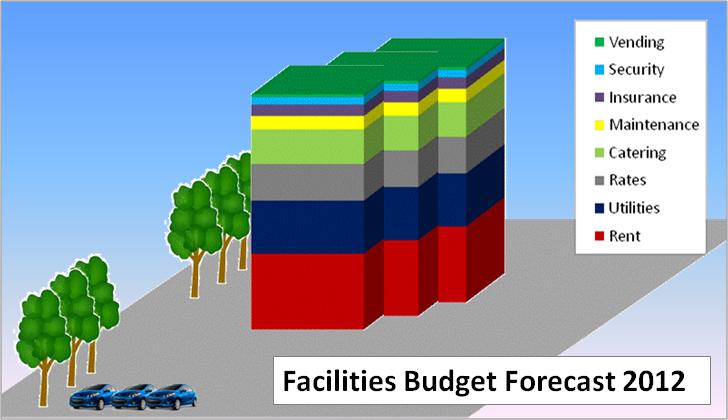
The graphic above is a recent favourite of mine.  At heart, it’s actually just a basic bar-graph of an FM budget, but to make it more interesting I’ve cut and pasted it together so that it looks like a building. To reinforce the message I’ve added a couple of trees and cars.  I really like the message that this gives, the fact that everything up to the first floor is the rent is something people can easily relate to without having to know the actual percentages or figures and if you can make it the same shape as your building, people will find it very easy to relate too.

The power of metaphor

I often find myself having to communicate information in stand-up presentations. I used to create very content-heavy PowerPoint slides to accompany my words when I did this, but that all changed when I saw what was probably, the best presentation of my life: It had no words, just three different pictures of dogs.  The speaker pulled up each picture in turn and explained why they were a metaphor for what his department was doing. It was something I’d never seen before and I was immediately sold.


Recently, I used this image in a similar fashion.  I told my assembled industry colleagues that I thought it was the perfect metaphor for Facilities Management: lonely at times, challenging, exhausting, but ultimately, incredibly satisfying and personally rewarding. The whole room nodded in unison.

Don’t tell me, show me.

So next time you need to communicate something complicated to a customer or stakeholder, spare some consideration for using a visual communications method: Remember, one picture really can be worth a thousand words.