10 May 2012

Worth a thousand words?

Being good at communicating information to other people is an important skill for Facilities Managers. But when that information is actually quite complicated, communicating it isn’t always easy and a range of techniques needs to be used to ensure the message is delivered effectively.  At times like this I’m reminded of the old adage that one picture, is worth a thousand words.

Processing visual information


I always attend meetings with a notepad and four different, coloured pens. Whilst making notes, I tend to switch pens at random. The strange thing is, although I make notes, I almost never need to refer to them – which is quite fortunate really because my handwriting would put a doctor to shame. People often comment upon this (the coloured pens, not the handwriting) and ask me why. The explanation is quite simple: it’s a similar effect to the memory trick magicians use to remember the relative positions of cards in a deck. They’ll associate each card with a room in a house or different tube station, etc. In the same vein, I’m not so much remembering the information I write, as remembering what colour I wrote it in and where on the page it is written.  That’s because I, like most people, respond more readily to visual stimulation than other forms of communication.


As human beings, we have evolved to process visual information very quickly; Three million years ago it usually made the difference between getting lunch and being lunch. It’s a skill that has stayed with us and as a result the modern world is rich with visual content. From posters to television, from the internet to the apps on our mobile phones, we are very comfortable in getting our information in bright, shiny, primary colours and an effective communicator can take advantage of this principle to help them get their point across.

Understanding relationships

I first discovered the power of communicating information visually a couple of years ago. I was looking after an old building where the air-conditioning was in fairly poor order with a number of faults that needed to be addressed. The problem was exasperated by the fact that, what had been intended as an open plan space, had been subsequently partitioned without much consideration to the environmental systems. This had left Fan Coil Units spanning rooms and wall mounted controls serving units in other rooms.  It was a bit of a mess.To resolve the issue, we commissioned our maintenance company to do a full survey of several floors and come up with a cost for putting it right. The trouble was that even I hadn’t appreciated how much work needed doing. I ended up with a 90 page report (one for each fan coil) and a quote that made the director’s jaws hit the floor.
I was told I’d have to prioritise; do the greatest good first, and programme the rest for the following year. 


This left me with a bit of a dilemma – how to work out where money spent would deliver the greatest value? Fortunately, I had two sets of data I could draw upon to help me: I had quote (which I had asked the supplier to break down for me) and I also had some customer complaint data on a room-by-room basis that I could use as my justification. 


One slight complication though, was the whole open-plan/partitioning issue. Fixing a problem might involve working on more than one room at a time, so it wouldn’t be quite as simple as listing the rooms and listing the cost to fix them. Instead I decided to present the information visually. It looked something like this.


One of the ways using visual methods of communications excels over other forms, is the way in which it allows you to efficiently describe relationships. I colour coded the rooms on a simple traffic light system to show the complaint level and overlaid this with each of the pieces of work showing which areas they would impact and what the costs of that work would be. It took me two whole days to pick through the detail of half-a-dozen floors, but one meeting and ten minutes later, I’d managed to secure a lot more funding than I’d been led to believe was available. You see, seeing it in a visual format, allowed my stakeholders to relate to the data and to understand both the scale of the problem and what they would get for their money.

Visually interesting


Since that first success, I’ve experimented with a lot of different visual communications techniques. I’ll admit they can take a little time to prepare, but if they help get your message across and help you achieve the results you need, then that can be time well spent.
One of the things I’ve noticed is that visual communication can be extremely effective when you present your information in an unusual way. Especially if the way you communicate it helps people relate to what it is. If you can capture someone’s interest, the battle is already half-won. 
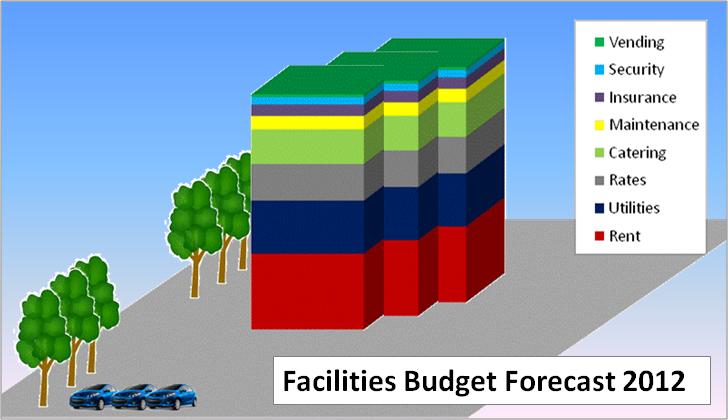

The graphic above is a recent favourite of mine.  At heart, it’s actually just a basic bar-graph of an FM budget, but to make it more interesting I’ve cut and pasted it together so that it looks like a building. To reinforce the message I’ve added a couple of trees and cars.  I really like the message that this gives, the fact that everything up to the first floor is the rent is something people can easily relate to without having to know the actual percentages or figures and if you can make it the same shape as your building, people will find it very easy to relate too.

The power of metaphor

I often find myself having to communicate information in stand-up presentations. I used to create very content-heavy PowerPoint slides to accompany my words when I did this, but that all changed when I saw what was probably, the best presentation of my life: It had no words, just three different pictures of dogs.  The speaker pulled up each picture in turn and explained why they were a metaphor for what his department was doing. It was something I’d never seen before and I was immediately sold.


Recently, I used this image in a similar fashion.  I told my assembled industry colleagues that I thought it was the perfect metaphor for Facilities Management: lonely at times, challenging, exhausting, but ultimately, incredibly satisfying and personally rewarding. The whole room nodded in unison.

Don’t tell me, show me.

So next time you need to communicate something complicated to a customer or stakeholder, spare some consideration for using a visual communications method: Remember, one picture really can be worth a thousand words.
 

22 March 2012

The Sophisticated Customer

One of the most frustrating challenges for anyone in a service industry is the customer who doesn’t really say what they want. How can you be expected to exceed their expectations, when they haven’t clearly articulated what those expectations are? Facilities people face this challenge all the time, but when the shoe is on the other foot, are we any better?

Facilities people are customers too. 

Procurement is a major function of Facilities Management. In small organisations a Facilities Manager might do all their purchasing by themselves. In larger organisation they may be able to draw upon the support of various experts; procurement managers, legal teams, etc.  These experts are a useful resource to the savvy FM, but at the end of the day, their expertise only extends to their subject matter: they can help you write a watertight contract, but they probably have no idea if it delivers the right level of service or not. Making sure that the service meets the requirements of the business is the FM’s job.

So how do we as Facilities professionals ensure that the deal we are being offered is going to deliver exactly what we want it to?  Well personally, I’ve always thought the best way to get exactly what you want, is to start by telling people exactly what you want.

Buying Smart

I first heard the phrase "Sophisticated Customer" from a supplier and I immediately took a liking to it. I think it's the perfect way to describe someone who approaches procurement in a precise and detailed way: someone who buys smart.  Let me explain.

Imagine you want to buy a car.

If you just stroll into the nearest car dealership and announce that you want to buy a car, you could be driving home in anything from a clapped-out ford Fiesta to a shiny new Porsche.  If you don’t have some idea what you’re looking for, the range of options could be confusing to say the least. 

Of course if you’re smart, you’ll think it through before hand; you’ll work out what you need this car to do, what sort of mileage you plan to do, etc, and the friendly salesman will be able to show you some options that don’t leave you having to stick one of the kids in the boot when you're doing the school run. 

However, the sophisticated customer will work out exactly what they want before they step out of the door.  If you’re buying smart, you’ll know what make and model of car you are looking for. You’ll have decided already if it’s got to have alloy wheels and a sunroof and you’ve probably picked out a fetching shade of metallic green.  Basically, you’ve got a specification.
The reason for using a specification is that it enables you to give the details of your dream car to a number of garages and then buy it from the one offering the best deal.  You get exactly what you want and you get it at the best price.

Getting Specific

Many Facilities professionals use specifications as part of the formal tender process, but there's nothing to stop them being used anytime you buy something and they can be used when buying almost anything. I’m surprised they don't get used more often.

So we've established you can use a specification for virtually anything, the question now is what you put in it. The answer quite simply is: as much as you can. In my time I've occasionally come across people trying to procure services using a generic specification. Maybe they've missed the point, but the clue should be in the name; the idea is to be specific.

As a customer, the more detailed your specification is, the more chance you’ll stand of getting what you want. There’s an old saying about what happens when you assume – I won’t repeat it here, but let me say instead: assume nothing. When I look to bring in a service or product, my specifications tend to cover anything and everything I can think of that might be relevant.

The most important aspect of course, is to include details about what you are looking to buy; what it is, how many, how big, what colour, etc.  But you don’t have to stop there.
You can choose to specify the process for proposal submission; you can include contact information, dates for submissions and procedures for preliminary visits and queries. You may wish to define terms about ownership of equipment (like keys, phones, IT equipment), security, intellectual property, qualifications of personnel, environmental standards, Service Level Agreements, etc, etc. The list is virtually endless.

If you’ve ever struggled to get the right paperwork after the job has been completed, you might think it’s worth stating up front, exactly what you expect to be delivered before the invoice gets paid. Talking of payment; maybe you don’t want to pay invoices on the supplier’s standard 14 day terms, maybe 30 day terms suit you better. As a general rule of thumb, if you’re very specific about what want, you can usually get it, albeit, at a premium.

Finding The Right People

A detailed specification can help you to identify good suppliers.

The extent to which a supplier takes the time to read and understand your brief (and it’s easy to spot those who haven’t) and is prepared to tailor their service to meet your requirements, demonstrates the value they place on your business. 

You might think that many suppliers would react quite negatively to such a dictatorial approach, but if you’ve never tried it before, you might just be surprised. In my experience, good suppliers like doing business with sophisticated customers. It’s fair; they know that they will be quoting like-for-like against other suppliers. If they don’t win your business, it’s either because they weren’t right for it or they weren’t competitive, not because they were undercut by someone offering a substandard service at a reduced rate. 

Any supplier signing up to a detailed specification starts out with a clear and detailed understanding of what the service expectations are. This knowledge can be used by them to meet and exceed those expectations, to develop a successful partnership and ultimately retain the business on a long-term basis.

If this sounds like the kind of supplier relationships you want to have, my advice to you, is be sophisticated and start asking for what you want.

23 January 2012

BIFM: Being In Facilities Management

Being responsible for managing facilities, is not the same as being a Facilities Management professional.   Most of us stumble into FM by accident: we display a little practical capability at a time when something practical needs doing.  And then we discover that actually, FM offers variation, challenge and lots of opportunities for job satisfaction.  Some of us think that these things would make a good basis for a career and we choose to develop our knowledge, skills and experience and become Facilities Management professionals. The BIFM (British Institute of Facilities Management) is here to help.

Recently, I've been extremely proud to have been invited to join the BIFM Home Counties Region Committee.  It's prompted me to write this blog about my experiences with the BIFM and why I jumped at the chance to get formally involved.

British Institute of Facilities Management

For those who don't know, the BIFM is the professional body for the Facilities Management Industry in the UK. It’s run by industry members, for the benefit of fellow professionals.
Whilst professional bodies are commonplace in many industries, there are few which I believe, can benefit their members as much as the BIFM. In this blog, I explain some of the thinking for this rather bold statement.


One is such a lonely number

FM can be a lonely business: often under-resourced and usually over-stretched.

As a general rule, FM teams are small, at least at the management level. In fact, many FMs work alone. Sometimes they'll have reporting staff, but when it comes to management, they stand by themselves. Organisationally, they report to Operations Managers, HR Managers, Finance Managers, etc, but it can be quite rare event to come across an FM who reports to someone who has served their time in the trenches too and intimately understands the challenges.

For FMs this can be a source of great frustration. We all need someone to "sound off" to once in a while: someone who understands that you can't make machines work by shouting at them and that you can’t buy a new AHU off-the-shelf at your local Argos store. This is where the BIFM comes in.

The BIFM holds regular events where you can meet other professionals, swap anecdotes, nod-knowingly at the tales of others and get a fresh perspective. Sometimes we need to know that it's not just us - that others are in the same boat.

Together we are greater than the sum of our parts

"FM offers such wonderful variation", I once told a colleague. That was the day I spent half the day talking about building a new office and the other half sniffing my way around the building to try and locate the source of a mysterious odour .  An extreme example perhaps (and no, I never did find it), but the point stands.  Facilities Management is a catch-all job, but what it entails can vary considerably from one organisation to the next. FMs constantly find themselves facing new situations and unforeseen challenges. In many jobs, if you don't know the answer or come across something new, the first person you ask is the boss, but if your boss is the Operations Director, it's probably no good asking them what the requirements for Legionella risk assessments are, or how frequently the AHU filters should be changed - you just have to find out. Again, the BIFM can help.

The Institute was set up to facilitate the sharing of knowledge. Members are actively encouraged to network and share information, knowledge and experiences with one another. As well as its own user forums, the BIFM has very active communities on Twitter (search #BIFM) and LinkedIn. These communities can help you answer questions, find suppliers and resources and give you advice or techniques on how to deal with challenges.

The BIFM also publishes lots of information on its web-site including news, articles and Good Practice Guides, and will keep you well informed with all that is happening in the world of FM with magazine and newsletter subscriptions.

Monkey see - Monkey do

The main way we learn is by seeing others doing. I'm a great believer that FM Professionals can learn all sorts of useful skills and techniques from others in their organisations, but ultimately the question is this: if your organisation doesn't have many (or any) other Facilities Managers, who does it have who can teach you what you need to know?  Facilities Mangers need role models and mentors outside of their organisation more than most people.  Whilst you can learn many useful communications and management skills in-house, you may have to look further afield to learn about space planning or lifecycle management.

One of the greatest benefits of the BIFM, is the regular CPD (Continued Professional Development) events. These events are usually local and take place during the week, after work. They are an opportunity not only to meet other professionals, but also to learn more about a particular topic. 

Over the past year I have attended events featuring presentations and workshops on a whole range of topics; from catering to alternative power generation, from interactive building systems to facilities strategy planning.  These events have expanded my personal network, taught me new skills and techniques and increased my industry knowledge. In many ways I would say they have quite literally, changed my life.
Get involved

So my advice to anyone looking to make the transition from managing facilities, to Facilities Management is to join the BIFM and get involved.


It may seem a daunting experience to go to your first event. You may imagine a room full of seasoned professionals with encyclopaedic knowledge and decades of experience.  Well some of those people will be there, but the vast majority of delegates will be people like you; people with a passion for FM, who want to share, learn, understand and teach. 

15 December 2011

Agile Working – Should We All Just Pack Up And Go Home?

Information Technology has freed us from our desks. Fact. As a workplace, the humble office is losing market share to the kitchen, the coffee shop, the train and the pub. The question is; what are we going to do about it?

The great unasked question

The extent to which agile working practices will reduce the need for offices in the future is one of the hottest topics of debate in the FM industry at the moment. The subtext of that debate is clear; "what will become of us in a world without offices”?

The debate so far seems to have mostly focused around two key questions; Can Information Technology really deliver all that it promises? Will our employers and employees actually buy-in to it?

The answers to these two questions are pretty straightforward; Yes, it probably can and no, they probably won't. Well, not all of them, but of course some of them will.

The Facilities industry seems to be taking quite a passive approach to this issue, with FMs roughly falling into two camps, those who think it will be as bad as we imagine and those who don’t. I’m raising the flag for a third camp – it’s time for FM to fight back.

The good, the bad and the untapped potential

There are plenty of good reasons to work from an office and plenty of things that the home can’t do for you. Over a period of time, many employees will start to realise this for themselves.

However relying on negative factors to dissuade employees from home working is a poor strategy. Negative factors are obstacles, but obstacles can be overcome - you might not have an ergonomic chair at home, but you could get one. A better strategy is to focus on the positives, what the office can do for you that the kitchen table, the coffee shop or the pub can't.
An even better strategy is to focus on what the office could do for you.  Forget the pros and cons for a minute, and think about potential? What new things could you offer to your customers and how are you going to market them?  Think big.

iBuildings (if Apple made workplaces)

I’ve always thought that FM's can learn a lot from the wider world of business. Let’s view the problem in a business context: We provide a service (a place from which to work) and some of our customers are choosing to use a different service. So how do we win them back? Let's draw some inspiration from technology and marketing giants, Apple.

Years ago, Apple was in the home computing business. Ok, they still have a toe-hold in it, but these days they are mostly known for mobile devices. At one time Apple and Microsoft were evenly placed competitors in the home PC market, but Microsoft eventually won the market share and dominated for decades. Apple's response to this loss of market share is one of technology’s greatest success stories. They took their product and they changed it.

Apple took the computer made it into a fashion item and marketed it aggressively. It was cool. It was sexy. It came in different colours and it appealed to people who had never wanted a PC before.

They took that lesson and they made their computing devices smaller, portable. They innovated, bringing new technologies to their products; colour screens, touch screen, voice control, etc, until eventually they became the technology powerhouse we all know.

Imagine what Apple might do if they were in the FM industry: how would they respond to agile working?

Counting our blessings

Compared to the situation Apple found themselves in, we in Facilities actually have things easy. Apple had serious, organised, competitors. We don't. 

In fact, in the task of turning the office workspace into a must have product, we can apply quite a lot of resources. We can use our knowledge, skills and experience to find out what our customers need and give it to them. We can use our industry knowledge and networks to create dynamic, exciting and inviting environments within which to work: the kind of environments that drive collaboration and innovation and foster a sense of community culture. And to top it all off, we can devise a strategy to market this must have product to our customers and make them want to be a part of it.

Against all of that, John Smith's kitchen table doesn't have any resources at all. In fact, it's got nothing. It can’t compete.

Information Technology may have started off the game, but the ball is well and truly in FM's court now. It's time for the Facilities industry to step up to the line and show them how we play the game.

17 November 2011

TwitterComm’s for Facilities Managers.

If something’s worth saying, then it’s worth saying in 140 characters or less...............  Welcome to TwitterComm’s for Facilities Managers.

TwitterComm’s is a communications technique based around the popular micro-blogging website.  I have been using this technique for a few months now as part of my wider communications strategy and have found it to be not only very effective at delivering information, but also popular with my customers.

What is TwitterComm’s?

In a nutshell; TwitterComm’s is about making sure that the information you communicate is properly targeted, relevant and delivered in palatable and bite-sized chunks.

The aim of TwitterComm’s is to improve the chances of the message you send being read and assimilated, rather than ignored or deleted.


Despite the name, I’m not suggesting you use Twitter as a corporate communications tool (even I’m not that much of a maverick), but I am suggesting you treat your emails as if they were tweets.

140 Characters or less

Ok, so getting across all you need to say in 140 characters or less might be a bit of a stretch, but there is a principle here: time is money.

Each email you drop into a customer’s inbox is a demand for their time. Their time is as precious to them as yours is to you. If you can’t keep the salient points to a few sentences, they’ll soon stop reading. Remember you can only lead a horse to water............ you can’t make it drink.

There is some good practice to be learned from Twitter about how to keep things concise. Twitter provides you the opportunity to expand your message by adding a link. If you are communicating a new policy, ask yourself if you have to send the whole thing or can you post it on your intranet and send a synopsis and a link instead? People will know the policy has changed and they can “click through” at a time which is convenient to them.

Here’s a top tip from me: Clicking through provides what Sales people call an up-selling opportunity. Can the link take people to a directory page where they can also browse other policies, news, etc, rather than straight to the policy itself.

Need to know, want to know, nice to know

Relevance, like beauty, is in the eye of the beholder. People will not thank you for taking up some of their precious time to communicate something which they feel does not affect them. They will forgive you an occasional transgression, but do it too often and they’ll start to treat your emails like spam.

You should think about who your information is relevant too. It might be easier to send out an email to the ALL_STAFF distribution list, but do people on the top floor really need to know about the broken toilet on the first floor?  Can you send a targeted email to just the first floor?


Personally, I want my customers to know that when I send something to them, it’s relevant and/or, important to them. I try to apply the need to know, want to know, nice to know test.
If it’s something they need to know or have said they want to know, I send it to them direct. If it’s something that is nice to know, I try to put it where they can easily find it, i.e. on the intranet, notice board, next to the lunch menu, etc.

The power of positive thinking

It’s the nature of what we do, that most of the need to know information we communicate has a negative implication; failed air condition, car-park restrictions and out of service facilities are our bread and butter. But do we really have to be the harbingers of doom?

Your choice of words and language can drastically affect how your message comes across: are things broken or are they being repaired; are rooms out of use or are they being refurbished. Are improvement works taking place?

If you have been properly targeting your communications, you’ve already fought half the battle. Remember that broken toilet on the first floor? If that email went out to ALL_STAFF, then people on the top floor will have a perception that “the toilets are always broken in this place” even though problems with their facilities might be few and far between.

Strategic thinking

Whilst TwitterComm’s is a good way of delivering your message, It’s not without its drawbacks; some people will feel that you are not providing enough information or that they are not getting the level of interaction they would like.  As an FM you have to play these things by ear and be prepared to be flexible to your customer’s needs.

However, used properly, I believe that TwitterComm’s can form a very effective part of your wider communications strategy. It enables you to engage quickly and easily with your customers in a way which lets them know that you understand that their time is valuable.

12 October 2011

Lies, damn lies & metrics.

I'm told that if you measure it, you can manage it. I'm not sure that’s entirely true, but I have been a big fan of collecting data for quite some time.  Recently I've been wondering if I can make those numbers work harder for me.

I suppose the moment of truth came a few months ago during a business update presentation.  I work for a huge business, which has interests in all sorts of different markets in different areas of the globe. The update could have taken hours to run through, but the information had been condensed down onto just two PowerPoint slides.  Admittedly the slides were busy, but even so it was an impressive example of getting to the point. Vast sums of money and hours of activity boiled down to a few simple numbers which indicated how the performance of different areas compared both to the forecast and the previous period. 

This set me thinking; what is the real value of my metrics?  What do actually they mean to others?

I first started collecting data on my departmental activities to get a sense of the scale of the work being carried out. Being new into the job, I wanted to gain a better understanding of the volume of transactions, requests and complaints. The data has been very useful and has helped to inform and educate our customers as well as provide evidence that can be used to support our claims and refute misconceptions. 

It's was all very useful stuff and I was generally quite happy with how my numbers were performing until one day I noticed that they had started to turn on me.

It all started out, as it so often does in this line of work, with a sunny morning and a tripped out air handling unit. A few days later it happened again.

For several months I'd been very pleased to report a gradual decrease in the volume of issues logged about the comfort cooling as my engineers and I had gradually learned more about how to best squeeze performance out of the systems.  Suddenly, two unexpected events had thrown that out of the window.
On paper, August looked dreadful; an architectural monstrosity that blemished the otherwise tranquil skyline of my bar chart. I felt cheated.  Yes it had happened, but it was a freak event, the data wasn't really reflective of the real story.  It was then that I realised I needed a new metric.


This graph shows the number of issues logged over the course of the year to date

That was the day I stopped focusing on the volume of issues logged and started focusing on the volume of satisfaction instead. It sounds like much the same thing, but it's not.  Rather than reporting the number of people that said they were unhappy in a given month, I started looking at more positive metrics instead.  One of my current favorite metrics, is the percentage of working days where no one logs a complaint.  It doesn't matter too much if the chiller breaks down one day a month causing a spike of calls, the positive message is that for the other 19 days of the month, nobody called.  You can choose to report that as 10 complaints or 95% compliance. 

This graph shows the same set of data, but presented as the percentage of complaint free days

Sometimes I like to combine the compliance metric with a qualifier, to improve it further. You could argue that because people vary in their perceptibility to heat and cold, that one swallow does not a summer make. You could choose to set a threshold level to make the metric work harder; if you ignore those instances when only a single person feels too cold, you could get a better picture of just how often the system really fails to perform.

Some people might see this as "spinning the facts", but as long as you present your data with integrity and are very clear about what your metrics really mean, they will generally be well received; especially if you are prepared to explain why you have chosen to measure in that way. After all, the real value in metrics for the customer, is in comparing how you are doing, with how you were doing and how you hoped to do.

One last thought about metrics, is that there is one that set of data you should always record. In FM, thank you's can be few and far between; make sure you record every single one so that you can look back on them with pride during difficult days.

20 September 2011

So why have I started blogging?

Like all the very greatest misadventures, I got talked into this one by a lady. I think she'll know who she is, because at the moment she's my only follower on twitter, but for those who might come afterwards I'd like to make it quite clear where the blame lies.

The lady in question: Christine Jones of Tigermouth. My story starts last week at the BIFM Southwest region training day where Christine gave an inspirational presentation about how to raise your industry profile with social media. 

Now I've never really been impressed by social media.  I'd always thought of it as a fad. And besides, on the off-chance that one day time-travelling robot-killing machines might come back from the future to try and prevent me becoming the future leader of mankind, I decided not to make it too easy for them by putting my life on FaceBook.  I appreciate of course how unlikely that is, but you know what they say; failing to prepare is the same as preparing to fail.....

Anyway,Christine made an eloquent and compelling case which I will butcher in the most horrendous manner by paraphrasing it down to this; Get involved. Connect with people, share your views and your knowledge and in turn you will benefit from the knowledge and views of others in your network.  Essentially; become known.

It's great advice; Facilities people tend to be lone wolves.  Well some of us live in small packs (teams), but generally speaking we're on our own within our organisations. It's not intentional, but there are times when every FM feels like they have their backs to wall and that everyone is gunning for them. It goes with the territory - what we do is complicated.  Some people don't really understand it.  Some people don't want to understand it.  You'll know who I mean - when you start talking about air-conditioning their eyes get that same glazed over look that mine do when my wife starts talking about shoes. I guess the point I'm trying to make is that sometimes, the only place an FM's feel understood is when they are talking with other Facilities people.  For a lot of FM's, those "brothers in arms" are actually from outside of their teams, their offices or even their organisations.

For me this blog is about connecting with people. Sharing my ideas, knowledge and ignorance(!) with other professionals and maybe, just maybe, learning a little bit more in the process. But I don't want to limit my network to just Facilities people. There are people out there who are not FMs, but are open (or sympathetic) to Facilities issues they either have some understanding or experience or they're just interested in knowing more. I'd like to use my blog as a way of bringing FM to those people too. So for that reason, I'm not planning on getting too techy.  There are plenty of others out there who's knowledge far exceeds mine and all I'll end up doing is highlighting my ignorance. What you will get in this blog is my enthusiasm and passion for FM, my own (sometimes unique) point of view,  my thoughts about how to leverage FM to deliver real business benefits and of course my somewhat iffy sense of humour.

I hope after reading this, you'll continue to follow my blog; as those who know me can testify - I have quite a lot to say about almost any subject and it wold be a shame if no one listened.